
By Daniel Miner | Wed, October 7, 26
Data centers are here and they use large amounts of energy. A large data center campus using one gigawatt at peak demand consumes the same amount of energy as the city of Dallas. In the Northeast and Mid-Atlantic regions, data center projections are impacting energy costs and load forecasts, driving up costs in the PJM capacity market, and increasing risks of grid shortages.
The scale of energy use coming online to local grids indicates a rapidly transforming industry in need of strong guardrails to protect energy costs. States need creative solutions and policies including updated energy codes, which can reduce overall load and support independent solutions to grid management. Without proper statutory guidance, we cannot ensure energy efficiency is factored into the planning and construction of data centers. This blog presents the state of existing data center codes, which generally discourage creative energy efficiency solutions, and the initiatives underway that seek to address the issue through adoption of stringent energy codes and infrastructure investments.
Why Current Codes Miss the Mark
In the United States, American Society of Heating, Refrigerating and Air-Conditioning Engineers (ASHRAE) and International Code Council (ICC) codes have only just begun to address the scope of energy efficiency in modern data centers. ASHRAE Standards 90.4-2022 and 90.1-2025 are the current commercial codes that apply to data centers in many states. 90.1 provides requirements for energy-efficient design of most buildings and 90.4 provides an alternative compliance pathway for data centers. The codes provide credit for onsite renewable use and waste heat reuse in energy efficiency calculations. However, the application of these codes is ill-fitting for modern hyperscale size projects. ASHRAE 90.4 was first published in 2016, when a data center was conceived of as a component "server room or wing" in a larger office building, not the main element of a building with tremendous load. Today, new data center constructions still refer to 90.4 for the “data center” portions of buildings – i.e., mechanical, processing, and electrical components of server rooms – while 90.1 covers all other areas of the building, including offices, loading docks, and security command centers.
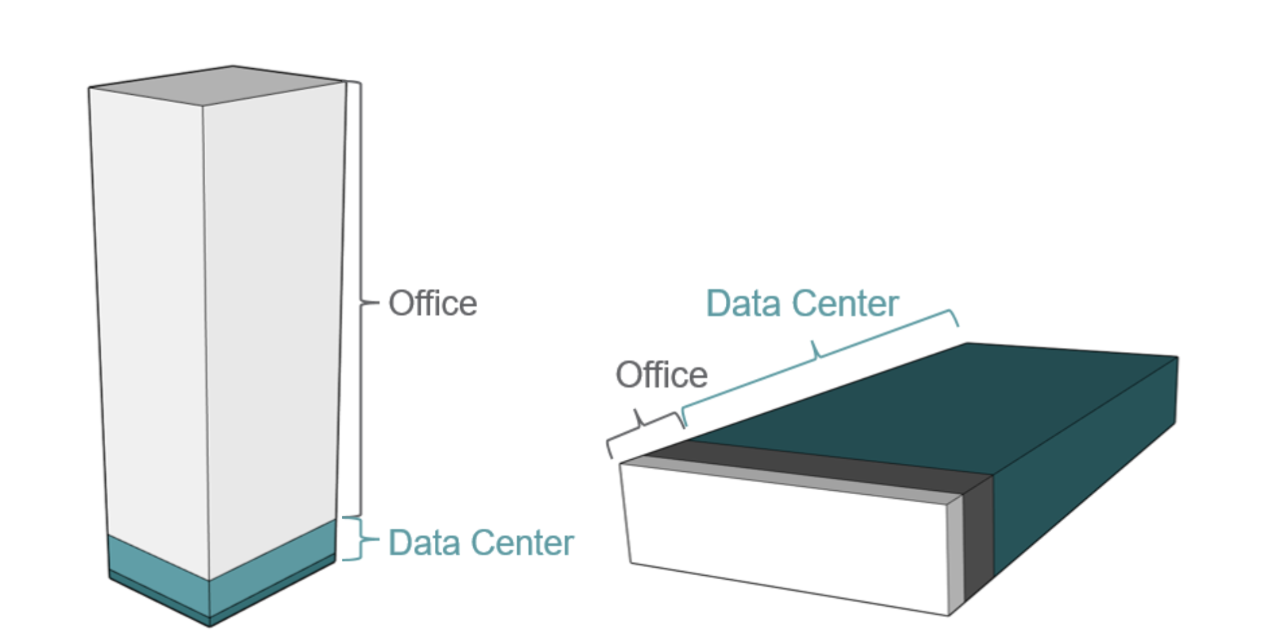
Figure 1 illustrates how data centers have migrated from smaller modules within larger office spaces to processing machines that use 85-95 percent of a building’s physical space. However, building codes do not yet fully reflect this change. Furthermore, certain elements of data centers, such as building envelope requirements, kick back to 90.1 standards, which are not yet calibrated for current data center construction.
To address these major gaps, model codes need to be updated with more specific building standards for data centers. Updated standards should emphasize solutions such as waste heat reuse and onsite renewable requirements. But states should not start from scratch — the use of 90.4 and 90.1 in tandem remains essential because both data center and non-data center spaces still need to be accounted for in a single structure. ASHRAE and ICC Code revisions should reflect the future of data center construction and account for building envelopes and mechanical systems with hyperscalers in mind.
How ASHRAE 90.4-2025 is Evolving
ASHRAE’s newest 90.4 standard, released in late 2025, answers some of the most pressing questions coming from modern data center development. A refined performance pathway helps ensure that efficiency is properly scaled with the ambition of hyperscale projects. Beyond increased energy efficiency provisions, an expanded purpose statement outlines greenhouse gas emissions, water use, and larger resource impacts as priority issues. Though there are no mandatory requirements in the 2025 edition for these issues, the standard enables the future inclusion of these in an expanded scope – meaning states may see direct requirements in the 2028 standard. Currently, 90.4 is a “code-intended companion” to 90.1 for several building aspects, so it is key that states look to harmonize their adoption of ASHRAE 90.4 updates with ASHRAE 90.1 updates. States looking for guidance in the arena of data center construction can turn to 90.4 for a starting point, while understanding that the model code landscape is still evolving on this topic.
G12 Guideline
The ICC is also looking to address data centers through developing the G12 Guideline on Data Centers, which has an expected publication date of early 2027. This effort is bringing together experts to draft a framework of technical code recommendations for new data center construction. From noise pollution to central water cooling, the G12 committee’s working groups meet weekly to draft new content which will inform and help establish stronger standards for data center design – any interested parties are welcome to participate in these working groups. G12’s collaboration with the ICC’s Code Action Committees will bring additional expertise to the guidelines. These recommendations will follow the outline of the current 2024 International Building Code and take the form of a data center-specific overlay to the existing code for ease of implementation. While several states are considering placing moratoriums on large data center construction, those that do not will be able to look to these guidelines to inform the treatment of modern data centers in their upcoming code cycles. As this process continues to unfold, NEEP will continue to participate and share relevant updates with our larger regional community.
Innovative and Efficient Solutions with Data Centers
States can also look to international efforts that provide models for sustainable solutions. Thermal Energy Networks connected to data centers in Europe, which are mandated by EU directives, and offshore wind-powered data centers in Asia are leading the way for energy-efficient innovations in data center construction. In the United States, Thermal Energy Networks could repurpose what would otherwise be heat pollution from data centers into local community heating, while creating an additional revenue stream for data centers from public utility buyers. As seen in the onsite renewable credits within ASHRAE 90.1, responsible practices like waste heat reuse could be incentivized through a credit system to achieve code compliance.
Cities like Boston and Philadelphia already have existing steam networks that serve the heating needs of about 170 million square feet combined – data centers could support existing metropolitan district heating plans. States like Virginia are taking notice of these developments and directing state agencies to identify waste heat reuse opportunities. These efforts can be integrated into energy code requirements through credit systems, alternate performance pathways, state subsidies, or other incentive/trade-off systems of compliance.
Looking Ahead
Innovative approaches to data center infrastructure will be essential to protecting stable energy costs and community welfare. NEEP is leading these discussions alongside community stakeholders and industry players to ensure community affordability and energy efficiency stay at the center of hyperscale projects. States can meet this challenge in part through comprehensive codes, including the soon-to-be released ICC G12 Guidelines and the most up-to-date editions of ASHRAE 90.4 and 90.1. In a rapidly evolving codes space, regional stakeholders must continue to be actively engaged in code solutions to foster community-conscious, energy-efficient data center development.