
By Tasneem Osman | Wed, July 1, 26
Massachusetts has emerged as a national leader in high-performance residential construction. The Commonwealth uses a unique three-tiered energy code framework that allows communities to advance building performance significantly beyond the minimum state standard. For residential projects, the technical requirements of the Stretch and Specialized code are rigorous. This technical complexity raises a question that emerged repeatedly through discussions with members of the Massachusetts Net Zero Buildings Coalition: How are projects complying with these advanced codes? What design decisions, technologies, and construction approaches are teams using to meet these codes across the state?
To help answer these questions, NEEP developed a series of seven residential case studies focused on sites outside the Metro Boston area. The projects span affordable multifamily housing, ADUs, custom single-family homes, and small-scale residential developments. Together, they illustrate the diverse pathways project teams are using to deliver high-performance housing under the Stretch and Specialized Energy Codes. Each project reflects a different set of priorities, constraints, and market conditions, offering practical insights for builders, designers, code officials, and policymakers seeking to advance high-performance housing across the Commonwealth.
Understanding Massachusetts' Three-Tiered Energy Code Framework
Massachusetts' energy code framework allows municipalities to choose from three tiers of increasing stringency, creating one of the most ambitious residential energy code landscapes in the country. Each code tier increases performance expectations in key areas including energy efficiency, ventilation, electrification readiness, renewable energy integration, and electric vehicle infrastructure, under the Base, Stretch, and Specialized Energy Codes framework.
Base Energy Code: Currently, 50 municipalities follow the state's base energy code, which is based on the 2021 IECC. This serves as the minimum statewide requirement for residential construction.
Stretch Energy Code: Currently, 242 municipalities, representing nearly 60% of the state's population, have adopted the Stretch Energy Code. The Stretch Energy Code establishes more stringent performance requirements than the base code. For residential buildings, this includes lower Energy Rating Index (ERI) targets, typically demonstrated through HERs scores. Additional requirements include mandatory balanced ventilation, electric vehicle readiness requirements, and solar-ready provisions for new one- and two-family homes and townhouses.
Specialized Energy Code: Currently adopted by 60 municipalities, representing 33% of residents, the Specialized Energy Code builds upon the Stretch Code and is intended to support Massachusetts' long-term decarbonization goals. The code introduces pathways toward net-zero energy performance through measures such as mandatory solar installations, enhanced electrification requirements, and Passive House requirements for certain larger residential buildings.
Multiple Pathways to High Performance
While each project in this study achieved the core goals of electrification and reduced energy consumption, the motivations driving these designs varied significantly depending on the project type and the priorities of the development team. This diversity suggests that there is no single "correct" path to high performance; rather, teams are successfully tailoring technical strategies to meet specific financial, personal, or educational objectives.
Affordable Housing, Financing as a Catalyst: The clearest trend across these case studies is the role affordable housing financing plays in advancing high-performance construction. Projects such as Amethyst Brook Apartments, Brewster Woods, Residences on Lincoln Square, and The Waterhouse were all developed using Low-Income Housing Tax Credits (LIHTC). In Massachusetts, LIHTC-funded developments are required to meet the Stretch Energy Code, regardless of whether a municipality has formally adopted it. Furthermore, the state's Qualified Allocation Plan awards competitive points for enhanced energy performance, including compliance with the Specialized Energy Code and Passive House certification.
This dynamic shifts high performance from an optional "add-on" to a de facto requirement, ensuring energy goals are baked into a project's financial planning and design process from day one. For these developers, high-performance design supports a multi-pronged strategy: improving competitiveness for state funding, stabilizing long-term operating costs, enhancing resident comfort, and protecting against future energy price volatility.
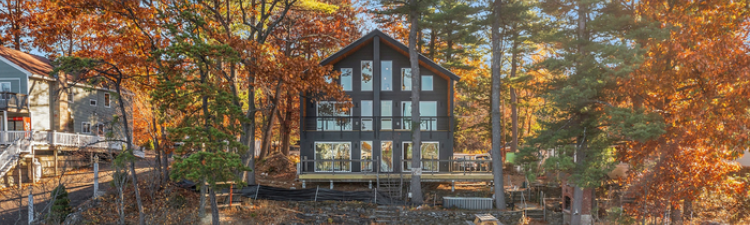
Prioritizing the Occupant Experience (Park Hill Residence): In contrast to institutional drivers, the Park Hill Residence was motivated by a homeowner's commitment to long-term health, resilience, and sensory comfort. The design integrated core passive design principles such as optimized solar orientation and a highly airtight envelope to create a net-zero residence. For this project, high performance was a long-term investment in quality of life, prioritizing quiet interiors, and reducing environmental stressors.
Replicable, innovative design (Casita de Vida): The Casita de Vida modular project served as a real-world laboratory for the UMass DesignBuild program, where the primary motivators were affordability and embodied carbon reduction. By involving students in the full project cycle, the program prioritized educational outcomes alongside technical performance. The team experimented with biogenic materials, such as straw bale panels and dense-packed cellulose, to demonstrate a replicable model for low-carbon, modular housing for affordable housing.
Practicality and Future-Readiness (Lunenburg Duplex): For the Lunenburg Duplex, the result was a practical and performance driven approach meeting the Stretch Energy Code. The team incorporated solar-ready infrastructure and EV charging conduit during construction at minimal additional cost. These decisions later enabled the installation of rooftop solar after occupancy, allowing the project to further reduce energy costs and improve overall performance without requiring major modifications.
Looking Ahead: Scaling High-Performance Housing
The case studies suggest that many elements of high-performance housing are becoming more standardized across Massachusetts. Envelope approaches increasingly rely on 2x6 framing paired with continuous exterior insulation strategies. Electrification through cold-climate heat pumps, heat pump water heaters, and balanced ventilation systems has effectively become the new baseline for residential construction under the Stretch and Specialized Energy Codes.
Across the case studies, access to specialized technical expertise emerged as a key factor shaping project positioning within high-performance housing development. Larger developers and well-resourced project teams were more likely to assemble multidisciplinary groups with prior experience in airtight detailing, electrified systems, advanced envelope design, and energy modeling.
By contrast, smaller developers and less-resourced teams may have limited access to this level of specialized support. This raises important questions about how technical capacity is distributed across the development ecosystem outside of the Metro Boston area, and for multifamily projects, how differences in access may influence a project’s ability to successfully compete for funding opportunities such as the Low-Income Housing Tax Credit.
Looking ahead, the findings suggest that the challenge is not about whether high-performance housing can be achieved and more about how these practices can be implemented consistently across projects with varying levels of experience and resources. Continued knowledge sharing, workforce development, and accessible technical support will be important for expanding the capacity to deliver high-performance housing at scale while maintaining affordability.